The AI That Reviews My PRs Signs Her Rejections With a Rose Emoji
July 17, 2026
There is an external party responsible for reviewing PRs in one of the codebases I am working on. They built an AI agent that does the reviewing. We add a tag, it reviews, and if we pass it, we pass.
That should not bother me. I have four AI reviewers of my own.
The problem is, this review agent's goal is to block potential bugs from coming in. It treats too many little things as potential bugs.
There are even some shameless false positives pointing to code my PR does not even touch.
I didn't argue, or read the reviews. My AI did.
This made me angry. A lot.
The feeling of anger was weird for me. I am not used to it. I am the defender of AI. Oh it's so good. It's great. You gotta learn to use it. Until it becomes the thing that blocks you, and everywhere is the slop that you need to sort through.
Since Fable 5 came out, I am having a real hard time liking AI. And I love using it.
When you have these powerful tools working for you, you want to do more, because you feel like you can do more. I ship at the potential of so many people. And to do more, you cannot stop and read everything. Especially not slop.
Most of the time I have at least 10 agents working on PRs at once. This requires completely different attention mechanics. I don't read my PR descriptions. I honestly don't read the code. I am not sure why I would need to.
I create research-backed specs with detailed input from my end. I explain what needs to be implemented, the specifics, the desired behavior, the non-negotiable constraints, and what done means. Done means the spec is implemented.
I rely on review agents testing the actual behavior in an environment, on tests, and on multiple different review agents reviewing the results. When my agents flag something in a review that they are not sure about and need my input, I give it my direct attention.
Instead of reading the code, I get my agent to explain the behavior around it: what calls the specific code, what data passes through it, why it was changed before, and what else could be affected by it. When my agents can do this so swiftly, I won't bottleneck them.
I think it's okay not to read the code in the AI age. The standard cannot be whether I looked at every token. The fix works or it doesn't. The tests pass or they don't. Four AI reviewers challenge the change before it moves forward.
And PR descriptions are probably not slop. They provide good context. But they provide the context mainly for AIs.
I like the way I use my AI. I don't have to like other people's.
Tüfek icat oldu, mertlik bozuldu. The rifle was invented, and valor was broken. That's a Turkish saying, from Köroğlu, a sword poet who met the age of firearms. "Mert" is the man whose bravery is real. After the rifle, anyone could pass for mert. The hardcore coders of yesterday know this story. Same with AI: you give them the Fable, and now every man is a whisperer of agents.
What Köroğlu mourned made so much sense, and had so much value. It just doesn't have value after the times changed. Not reading the code is fine, as long as you know how to use the rifle.
But the difference is the external party holds the key. I need to pass through their AI system. The AI I choose amplifies me. The AI I must pass through rules me.
This is the world we are building.
There is just so much to do. Time doesn't make sense. Building is free. And building powerfully is easy. Not taking full advantage is making me angry as well. I cannot keep up.
There is a PR I am working on right now. It is a fix for a real issue. Not a nit. A real one. The bot has reviewed it sixteen times. Sixteen times: changes requested. Ten of those reviews came in a single day. Round two surfaced two findings. Round fourteen surfaced ten.
They gave the bot a woman's name. My teammate says if you give them a name, they work better. Everyone calls it "her." I thought there was still time for us to get there.
She signs her rejections with a rose emoji.
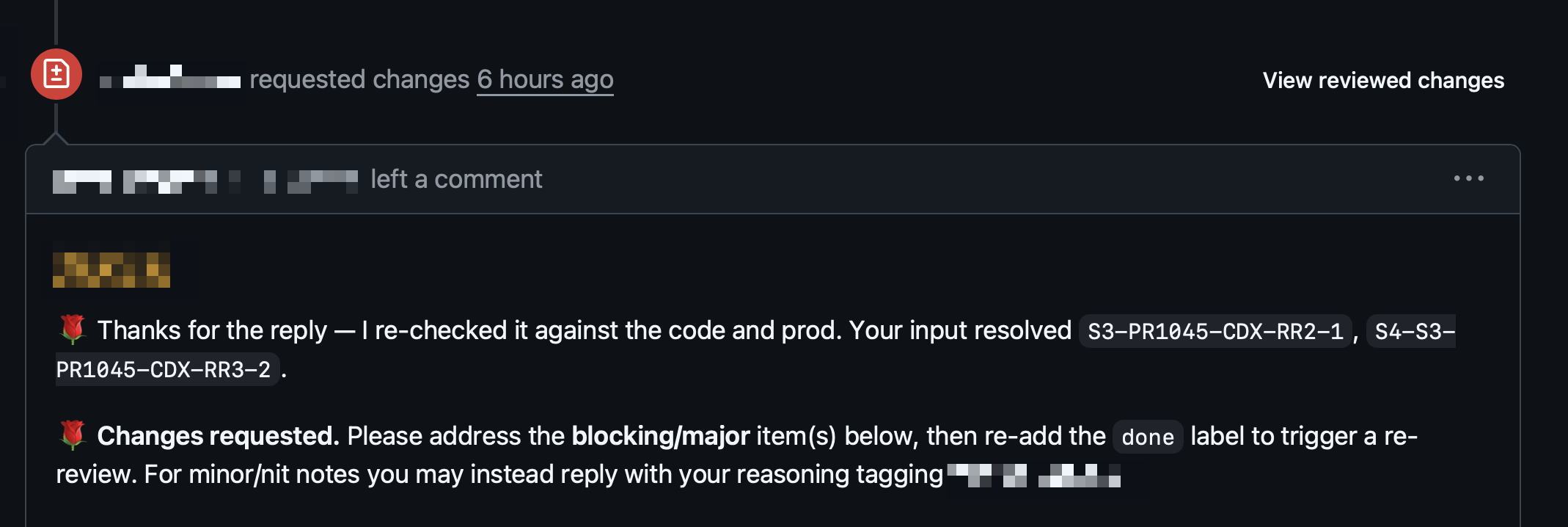
I won't back down, and the Slopper Shapper doesn't back down as well. I will add the tag. She will give me her false positives, and one nit that could be a huge problem if, in the future, this list of different conditions happens (unlikely). My agent doesn't agree automatically. It replies with detailed explanations. The review agent is convincing because it claims to have deeper knowledge about the business logic. They are the same breed. And a new round. Again and again.
The machines won this round.